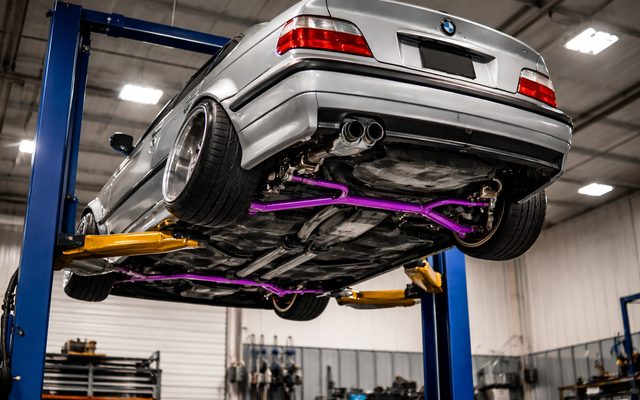
Inside the demanding arena of today's professional drifting, success is far more than purely a product of raw torque or behind-the-wheel courage. Instead, it has become a multifaceted science which requires a meticulous marriage of selecting a inherently capable chassis, equipping it with the highest-quality performance components, and, most critically, understanding its real-time behavior on the course through advanced drift telemetry software. This comprehensive manual functions as your blueprint from the initial idea of a competition vehicle through to the final telemetry-optimized refinements that transform a capable vehicle into a predictable champion. We will examine in detail the methodical process of chassis dynamics adjustment, illustrating how a modern suspension tuning tool like GripDial removes guesswork and provides unparalleled visibility into your vehicle's real-world dynamics.
The bedrock of any exceptional drift machine is, undoubtedly, the chassis itself. Several platforms have achieved renowned reputation within the worldwide drifting scene due to their inherent handling characteristics, durable construction, and the immense availability of aftermarket support available. Picking the correct starting point is the first and most important decision a enthusiast will make. As an example, the the E36 generation BMW is widely regarded as perhaps the the greatest balanced cars for drifting of history. Its near-perfect balanced front-to-rear weight, coupled with a rear-wheel-drive configuration and extremely reliable inline-six engines, creates a chassis that is simultaneously forgiving for newcomers and extremely effective in the control of a professional driver. The successor of this lineage, the BMW E46 platform, builds upon these attributes with a more developed structure, broader stance for enhanced stability, and even increased steering angle straight from the factory. A different dominant platform in the pro arena is the C6 generation Corvette.
This muscle-derived track weapon brings a distinctive set of strengths to the drifting sport, including a light alloy chassis, a transaxle-style drivetrain component that contributes to an excellent front-to-rear mass ratio, and the immense thrust of a powerful LS-series V8 engine. This combination transforms it into an complete monster on track, capable of starting and maintaining extended slides with apparently effortless use of acceleration. For builders seeking outstanding value, the 350Z model Nissan rises above as a prime candidate. It is delivered from the factory with a rigid platform, a competent factory limited-slip differential, and the responsive VQ series powerplant that offers ample performance for practicing and moving up in the sport. Its newer version, the Nissan 370Z, presents additional improvements in body strength, suspension design, and outright powerplant power, cementing its place as a popular pick among professional competitors. Other iconic vehicles that warrant consideration include the nimble rotary-powered Mazda FC RX-7, the ever-present S13 Silvia/240SX, the American Ford SN95, the electronic-equipped BMW E90, and the tiny yet surprisingly playful and forgiving Mazda Miata. All of these platforms offers a different array of traits, difficulties, and capabilities, but they all have in common the basic ingredients essential to become a capable drift machine.
However, picking the right platform is only the starting point. To unlock the true potential of every of these cars, substantial changes to the steering geometry and damping and springing systems are absolutely mandatory. This is where the domain of specialist tuning parts enters sharp focus. The one most game-changing modification for a dedicated competition vehicle is the integration of a drift-spec drift angle kit. These advanced assemblies, for example those manufactured by specialist companies like SLR Speed, are engineered to significantly expand the car's possible steering angle. A OEM street car is extremely restricted in how far its tires can rotate, a design compromise for public road driving. In sliding, but, maximum steering input is constantly needed to manage and sustain a slide. An modification kit exchanges the OEM uprights, tie rods, and often control arms with parts that permit the wheels to reach degrees of turn beyond 70 or even 80 °, as opposed to a normal OEM limit of around 40 to 50 degrees.
This tremendously greater steering angle offers the driver with dramatically more authority during a angle, enabling it to be much easier to begin a drift, maintain it through a sweeping corner, and transition smoothly from one direction to another. The contrast in controllability is absolutely revolutionary. Paired with a appropriately selected angle kit is the just as vital enhancement to the vehicle's spring and damper setup. Off-the-shelf or including high-end street coilovers are just not designed for the unique and brutal demands of sliding. A drift-spec set of adjustable dampers is of utmost importance. These specialized dampers incorporate specific damping rates and spring strength that are designed for the rapid mass transition that is typical of sliding. When a operator starts a drift, the vehicle's weight is thrown forcefully to the front of the turn. Proper drift-spec coilovers handle this movement in a consistent manner, allowing the vehicle to settle rapidly and providing the driver precise feel through the controls and seat. They additionally allow for precise adjustment of ground clearance, rebound and compression rate, and weight balance, which are all integral elements of dialing in the chassis's dynamics to a given venue or driving approach. As a system, a high-quality angle modification system and a expertly selected set of performance adjustable dampers form the core physical cornerstone upon which all subsequent optimization is constructed.
Once the essential hardware is fitted, the subsequent vital phase in the project is the meticulous tuning of the car's alignment. This is the domain of chassis dynamics adjustment, a methodology that can feel overwhelmingly complex to the newcomer but is, in fact, the secret to converting a assembly of capable pieces into a unified and predictable machine. The most debated aspect of tuning for sliding is definitely camber angle. Wheel camber is the tilt of the wheel in relation to the vertical plane when observed from the front of the vehicle. When the upper part of the tire is angled inward, this is known as inward tilt. In oversteer driving, an inward tilt on the steering tires is widely applied and is considered critical. The purpose is fundamentally tied to vehicle dynamics.
When a car is turning at extreme angles, the body tilts to the outer of the corner. This chassis roll makes the outside front tire to reduce its optimal footprint with the tarmac. By applying inward lean, the wheel is pre-angled to counteract this roll. As the chassis rolls into the corner, the outside front tire gains a better contact patch on the road surface, optimizing car alignment tuning its traction at the precise time when it is needed most for directional command. Usually, front axle angles for a dedicated sliding vehicle vary from approximately -3 degrees to as much as -5 degrees or even greater, depending on the specifics of the car configuration, compound choice, and pilot feel. The rear tires also employ negative camber, but the values are generally less and more nuanced than the front axle. Overly aggressive camber at the rear can make the car overly tail-happy and challenging to manage on acceleration input, as it reduces the effective tire footprint of the powered wheels during straight-line power delivery. Thus, rear camber settings are often in the vicinity of -1 degree to -3 degrees, achieving a delicate balance between giving sufficient side grip to aid in starting and maintaining the drift while simultaneously maintaining effective grip for exiting the turn. Camber is merely one component of the broader alignment equation, which additionally encompasses toe, self-centering steering, and suspension-induced steering adjustment.
Toe setting refers to the direction of the tires when viewed from the top. Positive toe means the leading edges of the tires are nearer together than the rear edges, while outward toe means the reverse. For sliding, a modest amount of front axle toe-out is frequently run to sharpen the turn-in directional response, making the car feel more nimble and willing to start a drift. Rear axle toe angle is typically set to zero or a incredibly minute amount of positive toe to promote predictability under power. self-centering is the longitudinal or aft inclination of the kingpin axis when viewed from the side of the car. Positive caster increases steering feel and high-speed confidence, and it also adds to camber gain during turning, which is highly beneficial. Setting these parameters is a intricate dance where a change to a single value can and will affect the others. The traditional process for dialing in a chassis's alignment for sliding has historically been a tedious endeavor of guesswork and adjustment. A driver or engineering group would apply a adjustment based on intuition, drive the car on track, use the driver's personal feel and comments, and then apply an additional adjustment. This cycle would repeat time after time until the chassis felt "acceptable" or the available track session ended. This methodology is not only exceptionally slow in terms of hours and costs, but it is additionally inherently imprecise.
Driver perception is a infamously unreliable metric, influenced by many variables such as fatigue, evolving track grip levels, ambient heat, and simply the focus of suspension tuning tool the operator on that given run. What feels "tail-happy" on one run might feel "tight" on the next pass, causing contradictory feedback and counterproductive adjustments. This age-old limitation in car suspension tuning is exactly where contemporary technology has intervened to completely change the landscape.
The development and adoption of sophisticated drift telemetry software has ushered in a new age for tuning and optimizing high-performance drift machines. This new generation of tools, showcased by cutting-edge products like GripDial, function by physically capturing the actual dynamic movement of the car as it is being driven on the course. Unlike relying on personal feel, these systems collect quantifiable information on critical variables such as suspension travel, individual tire rotation, lateral and longitudinal g-forces, lock position, and driver input input. This acquired information flow is then processed by advanced applications that can graph and decode the data in a comprehensible way. For the first time ever, drivers and crews can visualize specifically what the vehicle is performing at every moment of a drift. This function changes the whole suspension tuning procedure. Imagine the specific goal of setting the front axle camber for a particular vehicle. Rather than introducing a modification from -3 degrees to -3.5 degrees and then driving multiple runs to try and "feel" a change, a suspension tuning tool can provide immediate and definitive feedback. The tool can show visually how the tire's contact patch is behaving during the critical moments of a slide: initiation, mid-corner, and changing direction. It can demonstrate if the current camber setting is enabling the loaded tire to maintain maximum contact or if the rubber is working inefficiently on its external edge.
The software can after analysis provide data-driven advice for modification. Perhaps the information shows that the tire is even overworking its sidewall at -3.5 degrees of negative camber, implying that even more negative camber, say -4 degrees, might be beneficial. On the other hand, the data might indicate that the tire is failing to achieving heat or that the inside edge is wearing excessively, which could indicate that there is excessive negative camber and a slight reduction back to -3.2 degrees would be more optimal. This standard of granularity and actionable insight was simply impossible in the era of pure seat-of-the-pants setup.
The benefit of employing a dedicated vehicle dynamics tool reaches well beyond merely setting camber angles. It functions as an priceless suspension tuning guide that is tailored to your specific car. When fine-tuning the damping values on your adjustable dampers, instead of using vague tips or copying another driver's setup, you can use the software to see how the chassis is reacting in reaction to your adjustments. The tool can graph the damper movement data over a lap, highlighting if the dampers are handling the body movement effectively or if they are permitting the vehicle to bounce too much after a flick. It can help in identifying problems like bottoming out or losing droop, allowing you to apply informed decisions to preload settings, damping values, or stance. This approach applies equally to the complex task of suspension geometry optimization. Beyond camber, the system can give analysis into how adjustments to toe settings and caster are affecting the car's stability during specific phases of a drift. For instance, it can assist you to ascertain the ideal amount of front toe out for your particular steering rack geometry and piloting technique by analyzing the speed of initial reaction and the stability of the vehicle at lock lock. This makes the software an extremely useful performance optimization handbook that is actively updated by the live dynamics of your own car on the circuit. It elevates the whole process from a mysterious craft into a repeatable optimization procedure.
Moreover, the application of a system like modern telemetry is in no way restricted to experienced tuners with extensive resources. For the club-level driver, it acts as an incredible force multiplier. It effectively provides the builder with the knowledge of a full-time suspension specialist without the typical overhead. It drastically shortens the development time by giving unambiguous solutions to questions that would normally take seasons of experience to understand. A builder can see how their specific vehicle reacts to various settings, gaining a more intuitive comprehension of suspension theory in the journey. It additionally makes accessible high-level chassis dynamics techniques, allowing every enthusiast with the ambition to optimize their car to achieve it in a structured and productive fashion. This is particularly valuable in a discipline like drifting, where engineering knowledge has in the past been a closely guarded advantage among top teams. Now, that power can be in the garage of any motivated enthusiast.
In summary, the journey to engineering and dialing in the ideal championship-contending sliding vehicle is a comprehensive mission that seamlessly blends classic hardware knowledge with 21st-century digital solutions. It begins with the strategic pick of a proven platform, followed by the installation of essential performance components like high-performance drift angle kits and expertly valved competition suspension units. The build then advances into the intricate realm of car suspension tuning, where settings like camber, toe, and caster angle are carefully configured to match the car's modified geometry and the driver's personal needs. Ultimately, and what truly differentiates the modern methodology from the traditional methods, is the integration of a advanced drift telemetry software. This system eradicates the uncertainty and trial and error of purely seat-of-the-pants tuning by providing empirical, real-time telemetry on how the chassis is actually functioning. It acts as an unparalleled engineering partner, a comprehensive alignment optimization handbook, and a comprehensive chassis development system. Together, this drift telemetry software integrated philosophy ensures that all element of the drift machine—from the choice of the platform to the last click on the suspension—is refined for maximum performance on the competition venue. It signifies the full maturation of the discipline of drifting, connecting physical driving skill with data-informed vehicle setup to create the perfect dominant cars attainable.